Phase2_
 

The tools arrived first.
The vision arrives now.

A keynote on the AI paradox — and what to do about it.
 

Every industrial revolution produces the same paradox. The tools arrive first. The vision arrives later.

And in the gap between capability and imagination, entire companies make the wrong bet.

Phase2_
ServiceNow · 2026
0
0
Average enterprise AI maturity, out of 100.

The map got honest about  the territory.

The score fell not from retreat — but from finally grasping the scale of what real adoption demands. Companies stopped counting pilots and started asking what new value those pilots were creating.

Phase2_
The technology arrives

Everywhere but in the productivity statistics.

— Paul David, Stanford · 1990
1879
Edison invents the incandescent lightbulb.
1882
Pearl Street Station — 1st commercial grid.
1890s
Electric motors, commercially viable.
1900
Dynamos everywhere. Productivity flat.
The default, 1900

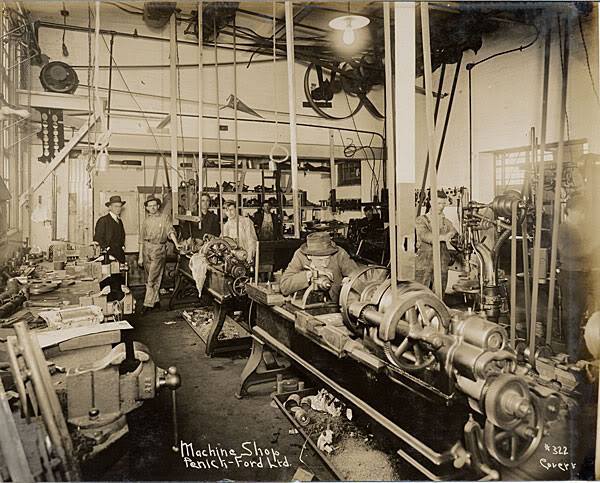
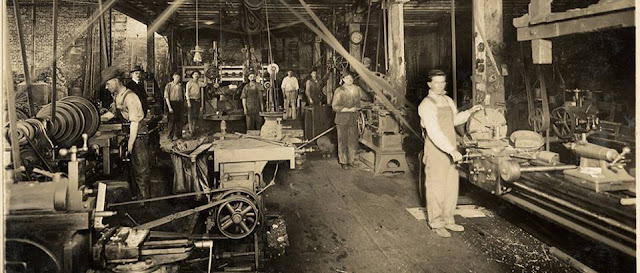
Swap the power source. Keep the factory.

Vertical
Compact & stacked
Machines clustered around a central shaft. Belts lost energy over distance.
Rigid
Layout frozen
Rearranging any machine meant redesigning the entire mechanical linkage.
Dark
Small windows
Poor ventilation. High injury rates from exposed belts and shafts.
Steam-era factory interior, line shafts and belts Steam-era factory interior, line shafts and belts
Phase2_

The revolutionary technology was available. Nothing happened.

3%
of U.S. residences used  electric lighting in 1900
<5%
of factory mechanical drive  was electric in 1900
40yr
before electric motor  diffusion hit 50%

The problem wasn't the dynamo. It was what people did with it.

Phase2_

Power sources failed because shafts and belts lost energy over distance, locking machines around the central shaft and freezing the factory's layout.

The factory's architecture was locked to the old technology. Electrification delivered only slight improvements and modest fuel savings, keeping the same layout.

Phase2_
What most asked...

How do we power our existing factory with electricity?

What Ford asked...

What kind of factory would we build if we started from scratch?
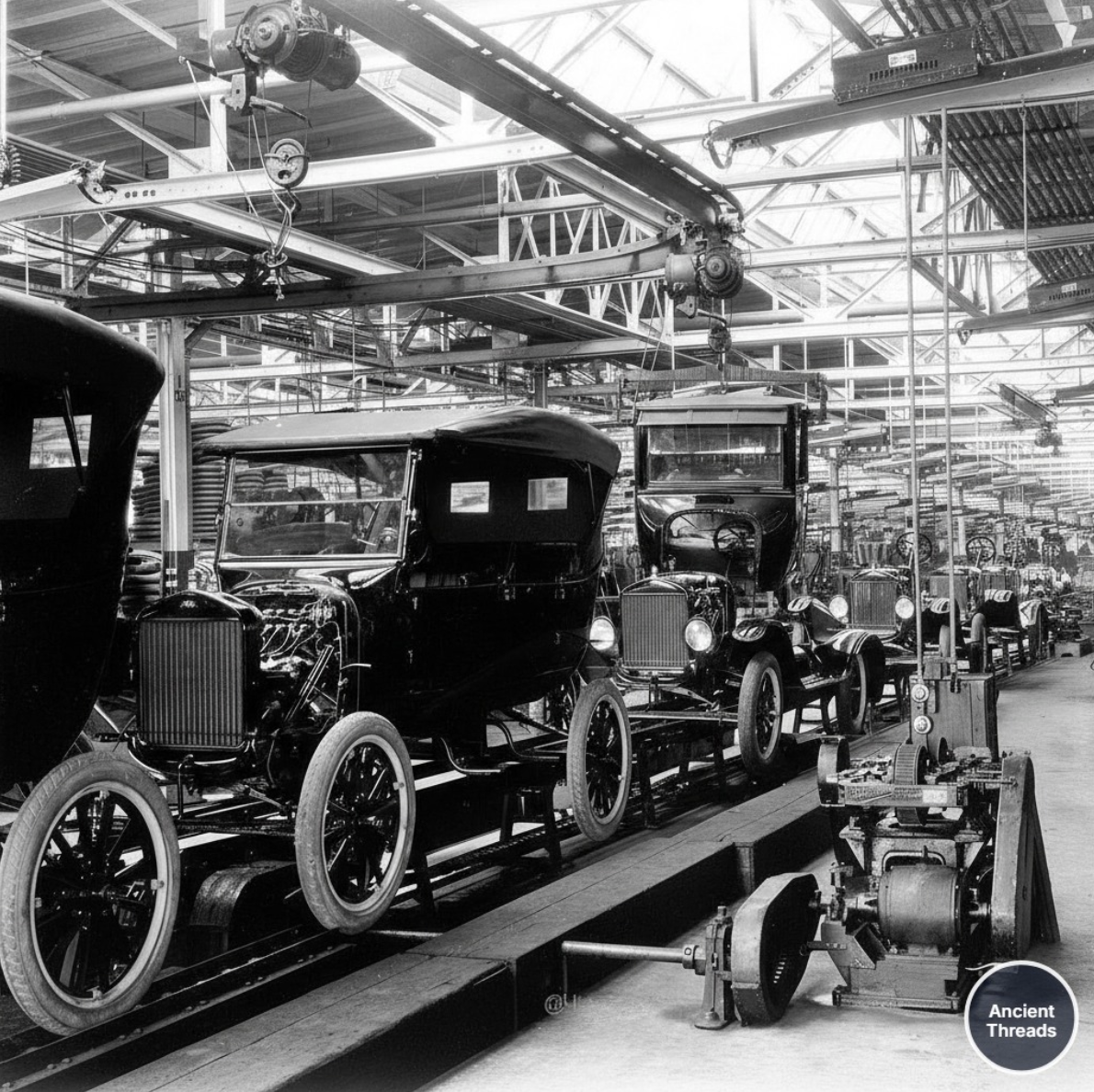
Ford's answer

A different factory.

Individual motors
One motor per machine. No shafts, no belts. Each machine independent.
Horizontal layout
Single-story factories organized around material flow — not power.
Flexible workflow
Machines rearranged freely. Lines reconfigured around production logic.
Light & air
Glass walls, skylights. Kahn's "Crystal Palace" design. Safer workers.
Highland Park-era assembly hall, unit drive and material flow
Phase2_

Ford's Factory by the numbers.

Reduced Assembly Time
−87%
728 93 min
Cut Model T Price
−70%
$850 $260
Model Ts Shipped
15M+
Largest manufacturer in  the world.
Phase2_

Better factories created better jobs.

$2.34 $5
Daily wage · Jan 5, 1914
More than doubled.
9hr 8hr
Shift length
More pay, less time.
32% 1.4%
Annual turnover
−96%, in two years.

The machine
isn't the constraint.

The real threat isn't falling behind in AI adoption.
It's misunderstanding what AI actually changes.

Phase2_
The world's largest furniture retailer

IKEA 2021, Billie goes live.

An AI chatbot for the predictable tide — delivery status, returns, product availability.

47%
of all inquiries resolved by AI
3.2M+
interactions handled
€13M
in direct cost savings

Most companies would celebrate the cost reduction, lay off the redundant staff, and present the savings to the board. IKEA didn't run that playbook.

Phase2_

What IKEA did instead.

01 · Listened
Studied the 53%
Billie couldn't resolve it — and found customers asking for interior design help. Taste. Spatial reasoning. Creative judgment.
Phase2_

What IKEA did instead.

01 · Listened
Studied the 53%
Billie couldn't resolve it — and found customers asking for interior design help. Taste. Spatial reasoning. Creative judgment.
02 · Reskilled
8,500 workers, retrained
Call-center staff became remote interior design consultants. Layered design, sales, and relationship skills on top of existing expertise.
Phase2_

What IKEA did instead.

01 · Listened
Studied the 53%
Billie couldn't resolve it — and found customers asking for interior design help. Taste. Spatial reasoning. Creative judgment.
02 · Reskilled
8,500 workers, retrained
Call-center staff became remote interior design consultants. Layered design, sales, and relationship skills on top of existing expertise.
03 · Built new value
45-minute video consults
A human who knew the catalog and could reimagine your space. New revenue line from the same workforce.
Phase2_
Cost saved
0M
Revenue created · FY22
0.0B
100× the return of cost-cutting alone.
Phase2_
The easy question...

"What can we eliminate?"

Treats AI as a sharper version of existing tools. Produces real savings. Completely misses the point.

The harder question...

"What can we elevate?"

Sees people, customers, and market position as potential — not fixed inputs. Expands into territory that didn't exist before.

IKEA: €13M saved → €1.3B created.

We have tools that can fundamentally reshape what a company is — and we're using them to make what the company already does slightly cheaper.

That's not transformation.
That's taxidermy — preserving the shape of something that should be evolving.

Taxidermied red fox in a glass display case
Jeremy Waller

So what do you actually do about it?

From diagnosis to practice — architecture, trust, and the right bets.
Phase2_

The pressure to act.

Without a strategy, more activity just deepens the chaos.

73%
of CEOs report stress over AI strategy
64%
fear losing their job over the AI transition
75%
admit their AI strategy is more for show than for guidance
39%
have no formal plan to drive revenue from AI
55%
describe AI use at their company as a chaotic free-for-all
67%
believe their company has suffered a data leak from unapproved AI
Phase2_

Spending accelerated.
Every barrier got worse.

33% 65%
Difficulty scaling use cases
25% 62%
Employee skills gaps
34% 59%
Difficulty quantifying long-term benefit
None of these are solved by better models or more compute.
Phase2_
The Productivity Gap

97% of individuals who use AI report real benefit, but only 29% of organizations see ROI.

48% call AI adoption a massive disappointment.

Phase2_
88%
of executives say their tools are adequate.
21%
of workers agree.
29%
are actively sabotaging the rollout.

Individual wins aren't compounding into business outcomes.
There is a trust gap.

Phase2_

So, what do you do?

From diagnosis to practice — architecture, trust, and the right bets.

01
Build the right architecture.
02
Earn trust progressively.
03
Pick the right bets.
Today's Stack
Software Layer
Applications · APIs · Workflows
Data Layer
Databases · Pipelines · Storage
Infrastructure Layer
Cloud · Compute · Networking · Security
runs on reads / writes runs on
Existing relationships
Intelligence Layer NEW LAYER
Agents · Models · Governed Memory · Orchestration
No vendor lock-in.
You own this layer.
Today's Stack
Software Layer
Applications · APIs · Workflows
Data Layer
Databases · Pipelines · Storage
Infrastructure Layer
Cloud · Compute · Networking · Security
runs on reads / writes runs on
reads / writes reads / writes runs on
Existing relationships
Intelligence layer relationships (new)
Phase2_

Four pillars of trustworthy AI.

Security
Zero-trust data
The AI only sees what it's authorized to see. Protects people, data, and decisions.
Governance
 
 
Reliability
 
 
Predictability
 
 
Phase2_

Four pillars of trustworthy AI.

Security
Zero-trust data
The AI only sees what it's authorized to see. Protects people, data, and decisions.
Governance
Policy built in
Aligned with business values, compliance, and ethics. Enforcement, not guidelines.
Reliability
 
 
Predictability
 
 
Phase2_

Four pillars of trustworthy AI.

Security
Zero-trust data
The AI only sees what it's authorized to see. Protects people, data, and decisions.
Governance
Policy built in
Aligned with business values, compliance, and ethics. Enforcement, not guidelines.
Reliability
Auditable results
Cross-validation, confidence scoring, and LLM failover — consistent across runs.
Predictability
 
 
Phase2_

Four pillars of trustworthy AI.

Security
Zero-trust data
The AI only sees what it's authorized to see. Protects people, data, and decisions.
Governance
Policy built in
Aligned with business values, compliance, and ethics. Enforcement, not guidelines.
Reliability
Auditable results
Cross-validation, confidence scoring, and LLM failover — consistent across runs.
Predictability
Non-determinism, managed
Human-in-the-loop, observability, and traditional code where it matters.
Phase2_

Progressive trust: the apprentice model.

All digital labor starts at zero trust.

S1 · Probation
Every action reviewed. Human approves all outputs.
Train
Phase2_

Progressive trust: the apprentice model.

All digital labor starts at zero trust.

S1 · Probation
Every action reviewed. Human approves all outputs.
S2 · Supervised
Routine auto-approved. Edge cases flagged for review.
Train  →  Supervise
Phase2_

Progressive trust: the apprentice model.

All digital labor starts at zero trust.

S1 · Probation
Every action reviewed. Human approves all outputs.
S2 · Supervised
Routine auto-approved. Edge cases flagged for review.
S3 · Trusted
Broader autonomy. Policy-gated on critical actions.
Train  →  Supervise  →  Verify
Phase2_

Progressive trust: the apprentice model.

All digital labor starts at zero trust.

S1 · Probation
Every action reviewed. Human approves all outputs.
S2 · Supervised
Routine auto-approved. Edge cases flagged for review.
S3 · Trusted
Broader autonomy. Policy-gated on critical actions.
S4 · Autonomous
Full operational authority. Within defined boundaries.
Train  →  Supervise  →  Verify  →  Expand
Phase2_

Value & Feasibility Framework

Source: Gartner · Customer Service AI Use Case Assessment

Value
Calculated Risks
Likely Wins
Marginal Gains
Quick Wins
Feasibility
Phase2_

The constraint was never the technology.

What is the one process in your business that, if you redesigned it from zero, would change everything downstream?

Phase2_

Learn more about Phase2 at
phase2online.com